
News

Extension Urban Forestry Academy 

Written by: Holly Campbell, Public Service Assistant
Approximately 82% of the US population lives in urban and suburban areas, environments which have several socio-economic and ecological stressors that can reduce human health and well-being and diminish ecosystem health. Urban trees help ameliorate many of the stressors urban areas face, for example by reducing air temperature and pollution, increasing health and well-being, and providing wildlife habitat and numerous ecosystem services. When urban trees receive quality growing conditions and experienced care, they can more easily achieve optimal health and growth, and as a result provide the greatest benefits back to urban areas. And trees are only one important part of the urban forest ecosystem.  

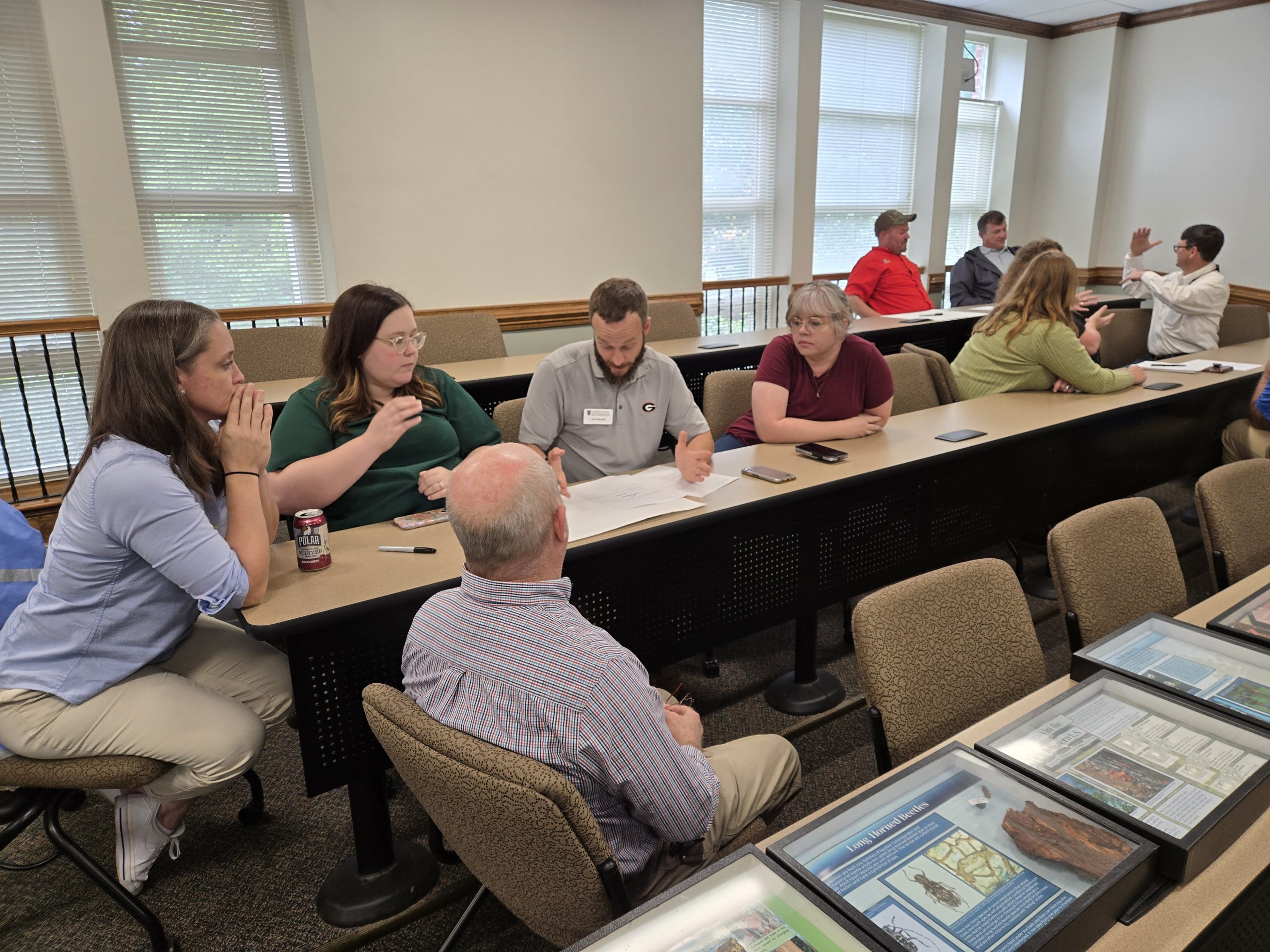
On May 7, 2025, UGA Warnell and Cooperative Extension faculty delivered the Extension Urban Forestry Academy to 20 UGA Cooperative Extension Agents at the Warnell School of Forestry and Natural Resources. The day-long event introduced best practices on tree pruning, tree risk management, and tree health, including an overview on common urban tree pests. The training also explored the important role of wildlife in the urban forest, from supporting wildlife habitat to discouraging nuisance behaviors. The Academy structure included a combination of classroom lecture, discussion, client scenario problem solving, and an interactive outdoor risk assessment activity. 

Participants expressed that “the variety of information was fantastic” and that they appreciated “thinking through issues in regard to tree [risk] assessment.” They also enjoyed the urban wildlife question and answer session, tree pest display boxes, and the interactive group discussions on tree pest and pruning scenarios.  

Participants unanimously agreed that a 2026 Extension Urban Forestry Academy would be well-received, especially including longer sessions on tree risk assessment, tree pest and disease diagnostics, tree pruning, and more. The academy will be proposed again through the UGA Extension Training System for 2026. 

Feel free to contact Holly Campbell, hollycam@uga.edu, with any questions. 

Extension Urban Forestry Academy 

Written by: Holly Campbell, Public Service Assistant

Approximately 82% of the US population lives in urban and suburban areas, environments which have several socio-economic and ecological stressors that can reduce human health and well-being and diminish ecosystem health. Urban trees help ameliorate many of the stressors urban areas face, for example by reducing air temperature and pollution, increasing health and well-being, and providing wildlife habitat and numerous ecosystem services. When urban trees receive quality growing conditions and experienced care, they can more easily achieve optimal health and growth, and as a result provide the greatest benefits back to urban areas. And trees are only one important part of the urban forest ecosystem.  

On May 7, 2025, UGA Warnell and Cooperative Extension faculty delivered the Extension Urban Forestry Academy to 20 UGA Cooperative Extension Agents at the Warnell School of Forestry and Natural Resources. The day-long event introduced best practices on tree pruning, tree risk management, and tree health, including an overview on common urban tree pests. The training also explored the important role of wildlife in the urban forest, from supporting wildlife habitat to discouraging nuisance behaviors. The Academy structure included a combination of classroom lecture, discussion, client scenario problem solving, and an interactive outdoor risk assessment activity. 

Participants expressed that “the variety of information was fantastic” and that they appreciated “thinking through issues in regard to tree [risk] assessment.” They also enjoyed the urban wildlife question and answer session, tree pest display boxes, and the interactive group discussions on tree pest and pruning scenarios.  

Participants unanimously agreed that a 2026 Extension Urban Forestry Academy would be well-received, especially including longer sessions on tree risk assessment, tree pest and disease diagnostics, tree pruning, and more. The academy will be proposed again through the UGA Extension Training System for 2026. 

Feel free to contact Holly Campbell, hollycam@uga.edu, with any questions. 

Categories

Archives