

Written by: Chuck Bargeron, Director for the Center for Invasive Species & Ecosystem Health, and Jay Shelton, Associate Professor of Fisheries
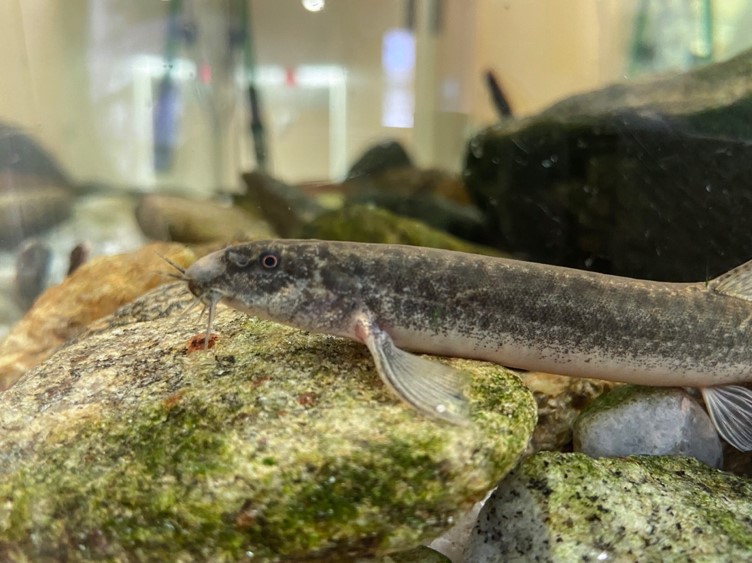

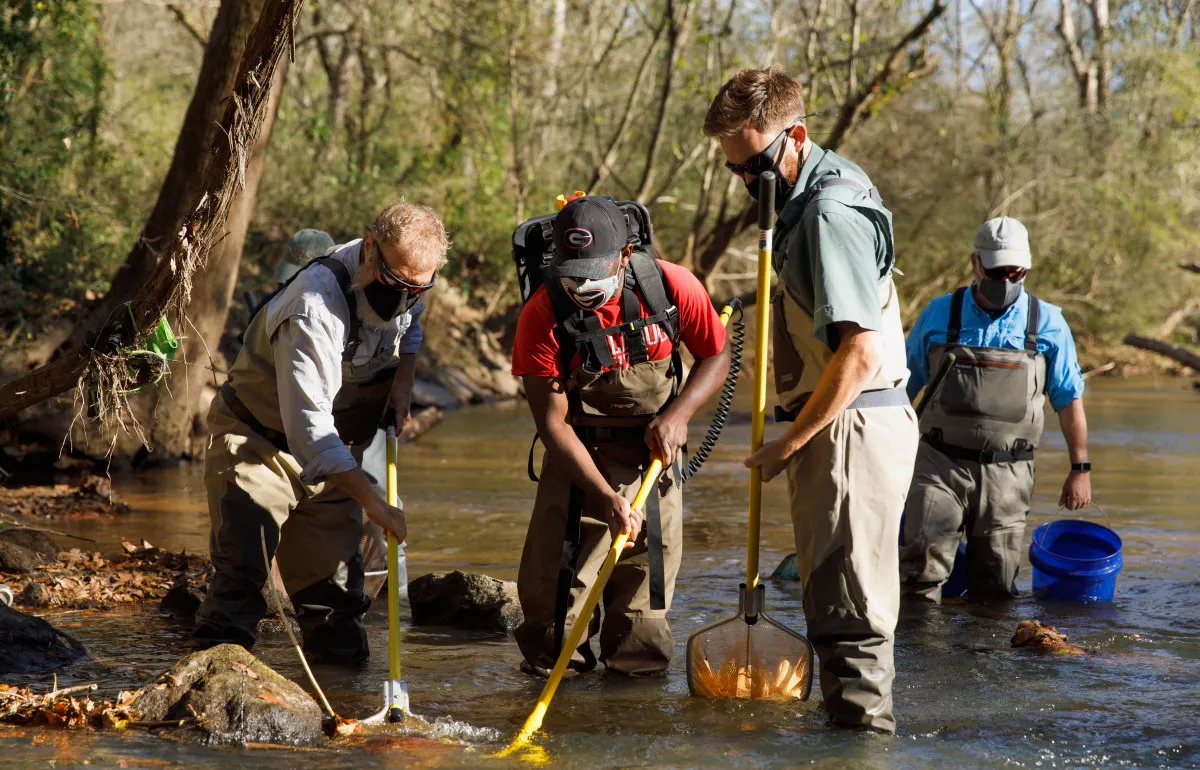
In November 2020, while conducting a survey for a class project, UGA Warnell School of Forestry and Natural Resources students collected a fish they could not identify. They immediately forwarded a photo to me via text message, and my response was: “I hope you’re at an aquarium store and not sampling in the stream!” The fish was a weather loach, Misgurnus anguillicaudatus, a species common in the aquarium trade. The survey was being conducted on a tributary of the Middle Oconee River, near Athens, GA. A total of 15 specimens were ultimately collected and retained for further study. While the weather loach (an Asian species also known as the dojo loach) has been documented in other states including Alabama, Florida, New York, and Oregon, this was the first recorded collection in Georgia. It is known to be a highly adaptable species that is a facultative air breather, can survive a wide temperature range, and is highly fecund.
We immediately contacted Jim Page, DNR senior fisheries biologist and aquatic nuisance species coordinator for Georgia. We also prepared a sighting report for the U.S. Geological Survey Nonindigenous Aquatic Species database. It was decided that the presence of a State threatened species, the Altamaha shiner Cyprinella xaenura, in this area, as well as concern over potential impacts on other local fishes warranted further investigation. In partnership with various stakeholders, we will continue to evaluate the status of this invasion, and plan to initiate a public education program to increase awareness of risks associated with invasives, and the importance of protecting native species. We hope to investigate how this invader will interact in the local aquatic ecosystem, and to determine how widely this introduction has become distributed. We will attempt to determine what the fish is eating in McNutt Creek, what kind of habitat it’s using and, perhaps most importantly, if it is reproducing. If the weather loach is found to be expanding its range, or if additional populations are discovered in other parts of the state, it will be added to a growing list of aquatic nuisance species impacting our waterways.

Declines in aquatic species are rarely caused by a single factor, more often it is the cumulative impact of multiple stressors. Populations of fish like the state-protected Altamaha shiner – which is found in this drainage – are shrinking primarily because of degradation, fragmentation and loss of optimal habitat. The addition of an invasive competitor like the weather loach can compound that decline because even though the weather loach won’t prey on adult Altamaha shiners, it could compete with them for food or eat their eggs and young.
Declines in aquatic species are rarely caused by a single factor, more often it is the cumulative impact of multiple stressors. Populations of fish like the state-protected Altamaha shiner – which is found in this drainage – are shrinking primarily because of degradation, fragmentation and loss of optimal habitat. The addition of an invasive competitor like the weather loach can compound that decline because even though the weather loach won’t prey on adult Altamaha shiners, it could compete with them for food or eat their eggs and young.
Weather Loach
Description
The weather loach, Misgurnus anguillicaudatus, is a slender, eel-like fish that is brown or gray with marble markings. The mouth of the loach is surrounded by three sets of barbels which it uses to find food. They can burrow into and hide in soft substrates or leaf litter. Maximum size in Georgia is probably under 10 inches.
Reporting
This highlights the importance of reporting unusual animals and plants that could be invasive species. Invasive species cost the United States an estimated $120 billion every year. The best defense for this is an educated public that reports new occurrences so there can be an early detection and rapid response. Invasive species can be reported online at www.eddmaps.org, using the EDDMapS smartphone app, or to your local county Extension agent.

Weather Loach
Description
The weather loach, Misgurnus anguillicaudatus, is a slender, eel-like fish that is brown or gray with marble markings. The mouth of the loach is surrounded by three sets of barbels which it uses to find food. They can burrow into and hide in soft substrates or leaf litter. Maximum size in Georgia is probably under 10 inches.
Reporting
This highlights the importance of reporting unusual animals and plants that could be invasive species. Invasive species cost the United States an estimated $120 billion every year. The best defense for this is an educated public that reports new occurrences so there can be an early detection and rapid response. Invasive species can be reported online at www.eddmaps.org, using the EDDMapS smartphone app, or to your local county Extension agent.